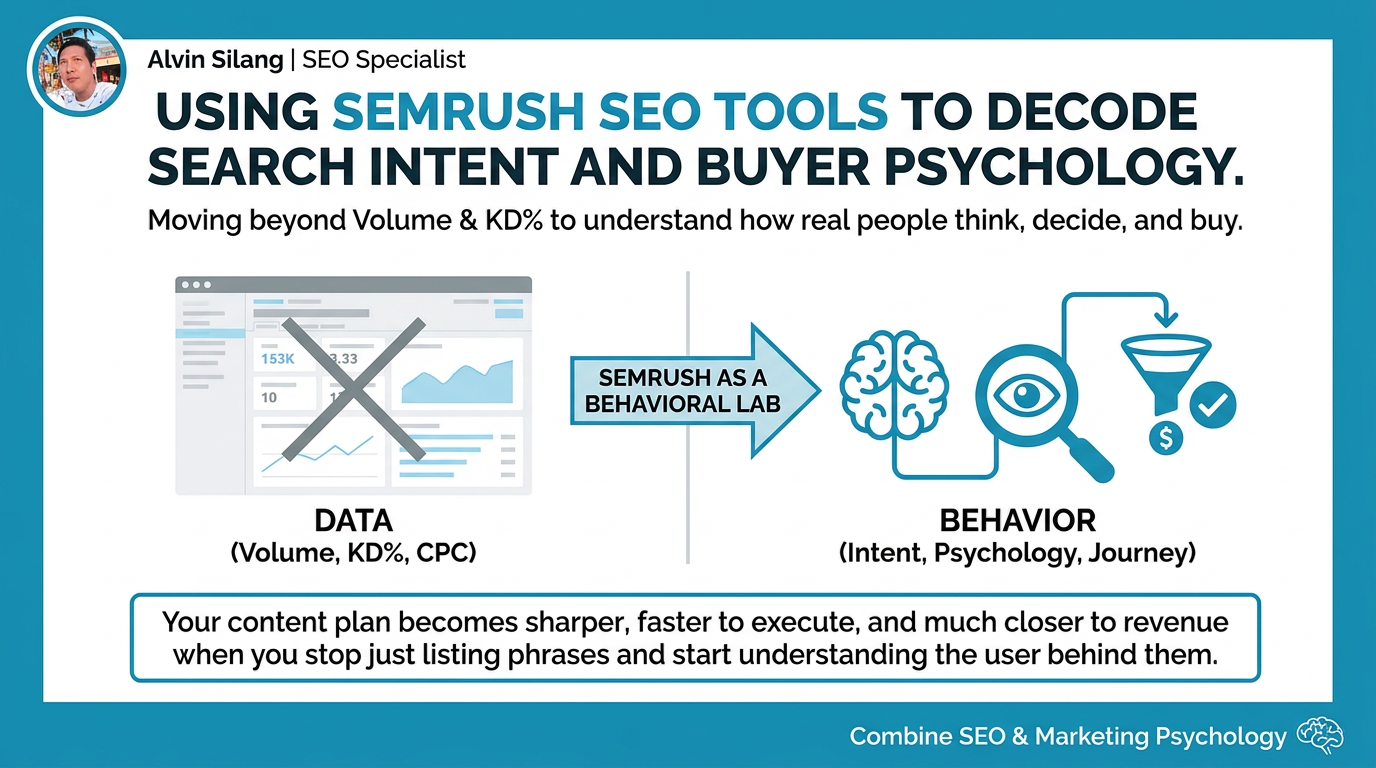
You load up Semrush, punch in a keyword, and stare at a wall of numbers.
Volume. KD%. CPC. Trends. A few colorful graphs.
You pick the highest‑volume keywords, brief a few blog posts, wait… and what you actually get is traffic that skims, bounces, and almost never converts. The data looked good. The results don’t.




The problem isn’t Semrush. It’s how you’re reading it.
If you treat Semrush like a list of popular phrases instead of a window into how real people think, decide, and buy, you’ll keep publishing content that ranks for the wrong reasons and attracts the wrong readers.
This is where marketing psychology meets SEO. The upside: when you see Semrush as a behavioral research lab instead of just a keyword tool, your content plan becomes sharper, faster to execute, and much closer to revenue.
Table of Contents
Why keyword volume alone keeps you stuck at the awareness stage
Most underperforming SEO strategies have one thing in common: they’re built almost entirely on Volume and Keyword Difficulty.
You type a seed keyword into Semrush. You sort by volume. You grab the ones that look achievable. You create “10 Tips…” and “Ultimate Guide…” posts. Traffic trends up, but:
- Time on page is low.
- Scroll depth is shallow.
- Lead forms and demo requests barely move.
Psychologically, here’s what’s going wrong:
- Volume shows popularity, not motivation. 40,000 people searching a broad term like “email marketing” doesn’t tell you why they’re searching or what success looks like for them.
- Difficulty hides intent gaps. A “low KD” keyword can still be a terrible fit if searchers are looking for tools and you offer consulting, or vice versa.
- You’re mixing decision stages. Awareness, consideration, and decision queries land on the same generic content. Readers don’t feel understood, so they leave.
Instead of asking, “How many people search this?” start asking, “What does this person believe, fear, and want when they type this?”
Semrush already gives you clues. You just have to know where to look.
Reading SERP features in Semrush as psychological signals
Every SERP feature that Semrush shows you is a hint about mindset.
When you look up a keyword in Keyword Overview or Position Tracking, note which features appear:
- Featured snippet
- People Also Ask (PAA)
- Video carousel
- Reviews / star ratings
- Sitelinks
- Local pack
- Shopping results
Each one corresponds to a rough intent profile.
1. Featured snippets and PAA: “Teach me and reduce my uncertainty”
When Semrush shows a featured snippet or a dense People Also Ask box, Google believes the main job of the page is to answer specific questions.
Psychologically, that means:
- Users feel uncertain and want clarity.
- They prefer direct answers over storytelling.
- They’re at a higher‑up funnel stage but open to guidance.
On your pages targeting these keywords:
- Lead with “What is…”, “How to…”, “Why…” answers above the fold.
- Use short, snippet-friendly blocks: 40–60 word paragraphs, clean lists.
- Add micro‑commitments: “Download this checklist,” “Try this template,” to turn curiosity into a small conversion.
2. Video carousels: “Show me, don’t tell me”
If Semrush shows a consistent video carousel, the intent leans toward:
- Demonstrations (how it works).
- Visual reassurance (what I can expect).
- Lower cognitive load (watching instead of reading).
Your content plan should:
- Pair long‑form guides with short explainer videos.
- Embed your own videos near the top to match this preference.
- Use thumbnails and captions that promise a before/after or a step‑by‑step outcome.
3. Reviews and shopping: “Help me justify spending money”
SERP features like reviews, star ratings, and shopping results scream commercial intent.
The buyer mindset here:
- They’re already sold on the category, not yet on the brand.
- Their main driver is risk reduction: “Is this worth it?” “Will this work for me?”
Content decisions:
- Put comparison tables, pros/cons, and social proof high on the page.
- Use specific, outcome‑based copy: “Save 4–6 hours a week,” not “Save time.”
- Include “Who this is for / not for” sections to reduce post‑purchase regret fear.
4. Local and maps: “Solve my problem nearby, today”
Local packs and map results indicate:
- High immediacy (“near me,” “open now”).
- Trust built through proximity and social proof (reviews, photos).
Even if you’re not local, this tells you something: users want speed, clarity, and proof. Reflect that with:
- Fast paths to contact or book.
- Clear service areas and response times.
- Prominent testimonials with location or industry tags.
Using Semrush topic clusters to mirror how buyers think
Semrush’s Keyword Magic Tool and Topic Research don’t just organize keywords. They reveal how people mentally group problems and solutions.
When you enter a seed keyword:
- Switch from the raw list view to Clusters, Broad Match, or Questions.
- Look at the most common modifiers: “best,” “vs,” “how to,” “for [niche],” “examples,” “pricing,” “template.”
Each modifier is a mini psychological script.
- “Best” / “top” / “review” = I’m comparing options and want social validation.
- “Vs” / “alternative” = I’m stuck between choices and fear making the wrong one.
- “How to” / “guide” / “step by step” = I want competence and confidence.
- “Template” / “checklist” = I want to save effort and avoid missing steps.
- “Pricing” / “cost” = I’m close to deciding but anxious about value.
Instead of treating clusters as siloed content ideas, build decision journeys:
- Map clusters to stages: awareness, problem framing, solution search, comparison, decision, post‑purchase.
- Plan content so a reader can move naturally from one piece to the next, each reducing a different fear or question.
Example for a B2B SaaS tool:
- Awareness: “how to automate client reporting”
- Problem framing: “manual reporting vs automated reporting”
- Solution search: “client reporting software”
- Comparison: “[Your tool] vs [competitor]”
- Decision: “[Your tool] pricing,” “client reporting software for agencies”
Semrush gives you all of these. Your job is to arrange them in the order a real human would think.
Turning keyword lists into psychology‑driven content blueprints
Once you’ve pulled your keywords and read their psychological signals, you need to convert them into actual pages that can rank and convert.
Here’s a simple, repeatable blueprint you can use for each high‑value topic cluster.
1. Choose one “anchor” intent per page
Avoid throwing every modifier on a single URL. Each important page should have a primary psychological job.
Examples:
- Reassure and educate → “what is…”, “how to…”, questions.
- Compare → “vs”, “best”, “top”, “review”.
- Close → “pricing”, “cost”, “discount”, “trial”.
In Semrush, tag your keywords by intent (Informational / Commercial / Transactional) and by dominant emotion: uncertainty, risk, effort, FOMO, etc.
Build one main page for each emotion‑heavy cluster.
2. Design the layout around decision moments, not word count
Stop writing to a number (“We need 2,000 words”). Start writing to what must be resolved in the reader’s head.
For a commercial comparison page, structure like this:
- Short intro that names their dilemma (“You’re probably choosing between…”).
- Clear comparison table above the fold.
- Key differences framed as outcomes, not features.
- Social proof aligned with their use case (“Agencies who switched from X saved Y hours”).
- Risk reducers: guarantees, FAQs, “who this is for / not for.”
Semrush won’t give you that layout, but it does show the SERPs of pages already winning. Use the SERP Analysis to:
- Scan top competing URLs.
- Note which headings they all share (these are must‑have subtopics).
- Add the missing psychological elements (risk, emotions, objections) they ignore.
3. Bake questions and objections into your H2s and microcopy
From Keyword Magic Tool and People Also Ask:
- Export the list of questions.
- Group them by theme: setup, pricing, usability, integrations, results.
Turn the biggest question themes into:
- H2 / H3 sections: “Is [tool] worth it for small teams?”
- FAQ blocks near CTAs.
- Inline reassurance copy near forms and buttons.
You’re not just matching keywords. You’re pre‑answering objections at the exact spot where friction would normally kill the conversion.
Setting Semrush projects up to track behavior, not just rankings
SEO without behavioral feedback is guesswork dressed up as strategy.
You can use Semrush Projects to connect classic SEO metrics with on‑site behavior that reflects real psychological states: confusion, interest, trust, and intent.
1. Build a “money page” segment in Position Tracking
In Position Tracking:
- Add only URLs that have a clear business goal: service pages, high‑intent blogs, comparison pages, pricing.
- Track the subset of keywords that map to buyer‑stage intent (“pricing,” “vs,” “[tool] for [niche]”).
This lets you separate bragging‑rights rankings from revenue‑relevant rankings.
2. Combine Semrush with analytics for behavioral signals
Semrush itself won’t show you scroll depth or form interactions, but use its URL and keyword lists to:
- Build segments in GA4 (or your analytics tool) for organic traffic to each intent cluster.
- Compare behavior:
- Informational pages → should show high scroll depth and internal link clicks.
- Commercial pages → should show higher CTA clicks and conversions.
If your high‑ranking commercial pages have:
- High exit rate.
- Low interaction with CTAs.
You likely have a psychological mismatch: the page talks features while the reader worries about risk, proof, or effort.
3. Use Site Audit insights as friction checklists
Technical friction is psychological friction.
In Site Audit:
- Fix slow LCP and CLS issues on pages where buyers make decisions (pricing, checkout, demo requests). Speed reduces anxiety and perceived effort.
- Resolve intrusive interstitial issues that block content. Pop‑ups that appear before users get value trigger reactance (the feeling of being pressured), which kills trust.
- Clean internal linking errors so your suggested next steps (guided by your intent clusters) actually work.
Every technical fix is really a trust and comfort upgrade.
A simple workflow to build a psychology‑first content plan in Semrush
Put this together into a repeatable, 5‑step process:
- Seed & scan
- Enter core topics in Keyword Overview and Keyword Magic Tool.
- Note SERP features and top modifiers.
- Label intent & emotion
- Tag keywords as informational / commercial / transactional.
- Add a quick emotion note: uncertainty, comparison, risk, speed, effort.
- Cluster by decision stage
- Group keywords into journeys: discover → define → compare → decide.
- Identify one “anchor” keyword per planned page.
- Design pages around psychological jobs
- For each page, define: “This page’s job is to ___ (reduce risk / show how / compare options / justify price).”
- Draft outlines that answer key questions and objections early.
- Track behavior and refine
- Use Position Tracking + analytics to monitor both rankings and conversions.
- When behavior doesn’t match intent (e.g., commercial keyword, but educational behavior), adjust copy, layout, and CTAs to better match what searchers actually want.
When you treat Semrush as a behavioral research toolkit instead of a keyword vending machine, your content stops chasing traffic and starts aligning with how people think and buy.
And as you build out this kind of intent‑driven architecture, you’ll be in a strong position for later steps in this series—like applying ethical persuasion to your copy and designing pages that make readers feel safe enough to convert.