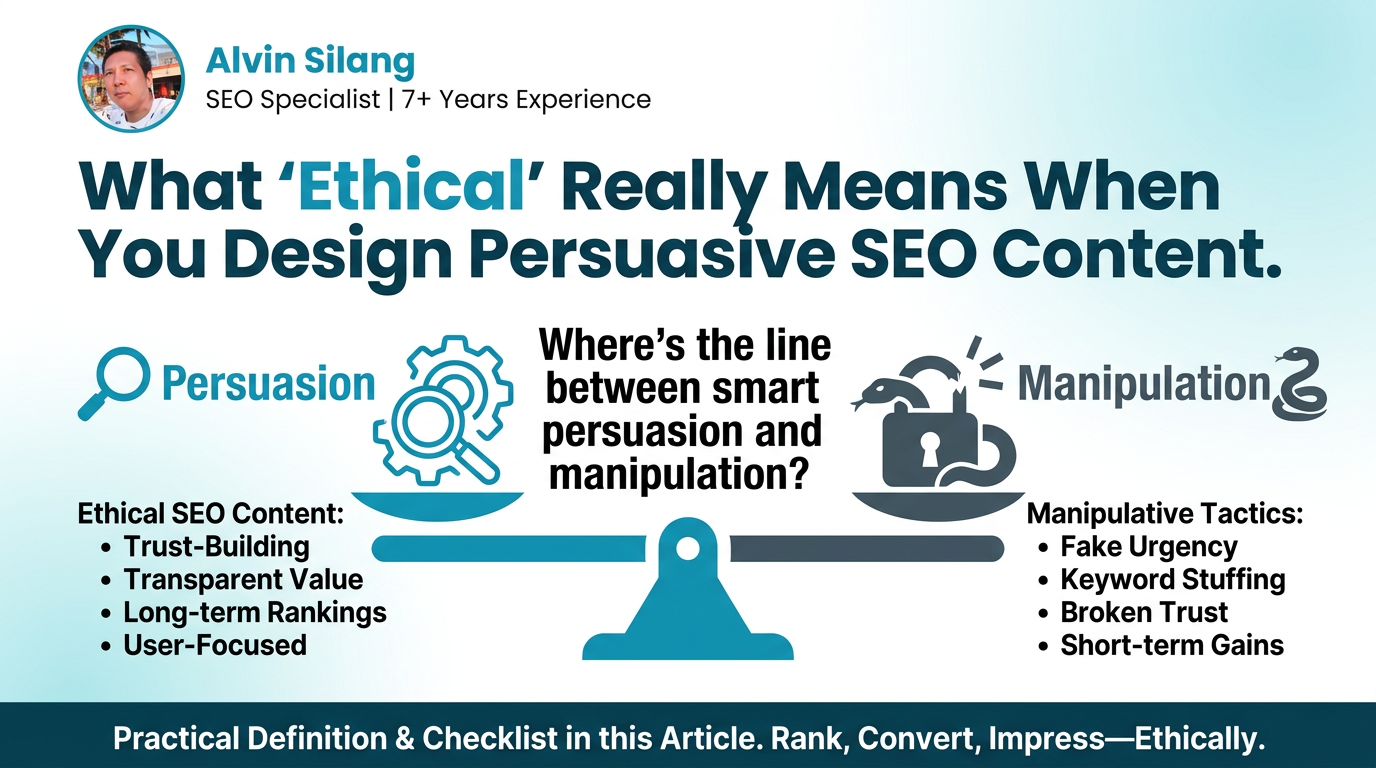
You want your content to rank, convert, and impress your clients or stakeholders. But the more you study persuasion, behavioral science, and copywriting, the more one question nags at you:
Where’s the line between smart persuasion and manipulation?
You’ve seen it: fake countdown timers, “only 2 left” messages that never change, keyword-stuffed pages that overpromise and underdeliver. Those tactics sometimes work short term, but they also trash trust, brand equity, and—eventually—rankings.




At the same time, you can’t afford to write “neutral,” purely informational pages that never ask the reader to act. Your job is to move people. So what does being ethical actually mean when you’re designing persuasive SEO content and using psychology on purpose?
This article gives you a practical definition and a simple checklist you can run every SEO page through—before it goes live.
Table of Contents
Why “ethical SEO content” is not the same as “soft selling”
Many marketers quietly equate “ethical” with “less aggressive” or “less effective.” That’s a false trade-off.
Ethical SEO content can still:
- Rank for high-intent commercial keywords
- Use urgency, social proof, and fear of loss
- Present your offer as the best choice
- Ask directly for the click, call, or purchase
What it cannot do ethically is:
- Hide or distort material facts
- Simulate risks or scarcity that don’t exist
- Block or bury information a reasonable user needs to decide
- Exploit vulnerabilities your audience can’t reasonably protect themselves against
Think of it this way: ethical persuasion is helping someone make a fast, confident decision that’s actually good for them.
That’s not “soft.” Done well, it often improves conversions because trust becomes part of the offer.
A working definition: the meaning of “ethical” in SEO and copy
Before you use a psychological trigger—scarcity, authority, FOMO—you need a concrete standard, not vibes.
Here’s a practical definition you can actually apply when you create or optimize pages:
Ethical SEO content is truthful, non‑coercive, and aligned with the long‑term interests of the user it’s targeting, while still serving clear business goals.
Let’s unpack that into three operational rules.
- Truthful
- No fabricated numbers, testimonials, or case studies.
- No misstated guarantees or selective disclosure that flips the meaning.
- No optimizing for keywords where your offer is clearly a bad fit.
- Non‑coercive
- You can create urgency, but not by manufacturing false risk.
- You can highlight pain, but not by shaming, degrading, or trapping people.
- You don’t use dark patterns (e.g., pre‑checked boxes, deceptive button labels).
- Aligned with the long‑term interests of the user
- The product/service genuinely matches the problem implied by the keyword.
- The likely outcome improves the user’s situation, not just your metrics.
- You’d still feel comfortable if this user left a detailed public review of their full journey—from SERP click to purchase to results.
If a page fails any of those three, it isn’t ethical, even if it’s technically legal.
Where SEO most often crosses the line (with concrete examples)
You probably aren’t forging testimonials. The gray areas happen in the details of intent, layout, and copy.
Here are specific spots where SEOs and content marketers slip from persuasion into manipulation:
1. Misaligned or hijacked search intent
- Ranking an informational article for “what is [condition]” and pushing a hard sales pitch halfway down the page.
- Targeting “best free project management tools” and only listing your paid product, with “free” buried in a tiny footnote.
- Using “vs” comparison keywords (e.g., “Tool A vs Tool B”) and faking neutrality while obviously favoring your own tool—without clear disclosure.
Ethical approach: Respect the intent hierarchy. Give the user what the query actually asks for first, then present your solution as one option, clearly labeled.
2. Inflated or fabricated social proof
- “Trusted by 50,000+ marketers” with no methodology, date, or source.
- Case studies with made-up numbers or unverifiable claims (“5000% ROI in one week”).
- Logos of brands that never used the product, or used it once on a free trial.
Ethical approach: Use real numbers, with context. If you can’t back a claim with a report, analytics screenshot (privately), or contract history, dial the claim down until you can.
3. Dark patterns around consent and choice
- Cookie banners where “Reject” is gray, tiny, or hidden in advanced options.
- Email opt‑ins where “No” is framed as self‑sabotage (e.g., “No, I like failing at SEO”).
- Checkout flows where add‑ons are auto‑checked, hoping the user doesn’t notice.
Ethical approach: Make the primary choices (yes/no, accept/reject) equally visible and understandable. Persuade in the copy above the buttons, not by booby‑trapping the buttons themselves.
4. Manufactured scarcity and urgency
- Fake countdown timers that reset on refresh.
- “Only 3 spots left” on a product that’s clearly not limited.
- Evergreen webinars with “live now” signals.
Ethical approach: Use scarcity only where it’s real: cohort start dates, live support capacity, bonuses with a genuine cost, seasonal pricing, or regulatory deadlines. We’ll go deeper on ethical scarcity in a later article in this series.
The Ethical Persuasion Checklist for any SEO page
You can’t run a legal review on every blog post. You can run a fast, structured ethical review.
Use this 9‑point checklist before you publish or re‑optimize a page.
1. Intent fit: “Should we even be here?”
- Does our offer truly match the dominant intent of this keyword?
- Would a reasonable searcher feel “tricked” landing on this page from that query?
If you’re ranking a sales page for an informational query, consider adding a high‑quality explainer section or creating a separate informational asset and interlinking.
2. Claim clarity: “Could this be misunderstood?”
Scan your H1, H2s, and key value props:
- Are we promising outcomes we can only deliver for a subset of users?
- Do we make “up to” claims look like typical results?
- Is there any stat or quote without a source you could show the client or regulator tomorrow?
If a claim relies on “well, technically, if you read it this way…,” it’s already over the line.
3. Evidence: “Would I bet my reputation on this?”
For major claims, ask:
- What proof do we have? (analytics, case studies, testimonials, before/after screenshots)
- Is the source of that proof clear (client initials, industry, timeframe)?
- Are we cherry‑picking the single best result and implying it’s typical?
If you’d feel nervous explaining the basis of a claim in a live call, revise it.
4. Emotional triggers: “Are we amplifying pain or weaponizing it?”
Psychology‑based SEO content should connect to real emotions, but:
- Does the copy shame the reader or label them negatively?
- Are we implying their identity or worth depends on buying this?
- Are we leveraging fears that the product can’t realistically reduce (e.g., promising career security from a low‑impact purchase)?
Aim for empathy + clarity, not fear‑mongering.
5. Scarcity and urgency: “Is this real, and is it clear?”
- Is the deadline or limit factually true right now?
- Could a reasonable user discover this scarcity is fake with minimal effort?
- Do we clearly say what happens when the deadline passes (price change, bonus removed, doors close)?
If scarcity exists only in the marketing software, not in your operations, remove it.
6. User control: “Can they say no without friction?”
Look at your CTAs, forms, and modals:
- Is the “no” or “close” option visible and understandable?
- Is any important choice hidden behind confusing labels (“Maybe later” that actually means “Yes, subscribe me”)?
- Can users access content without being forced into unrelated commitments (like mandatory newsletter signups for basic guides)?
Ethical persuasion invites, it doesn’t corner.
7. Data and privacy: “Are we honest about what we collect and why?”
From an SEO content standpoint:
- Do we clearly state when we’ll follow up by email and how often?
- Are we promising “no spam” yet planning aggressive drip campaigns unrelated to the original lead magnet?
- Are we using tracking or session recording tools the user has no reasonable way to discover?
Align your privacy copy with your actual practices, not the ideal you wish you had.
8. Vulnerable audiences: “Would this be okay if my younger sibling or parent saw it?”
Some niches inherently involve more vulnerable users (health, finance, addiction, employment).
Ask:
- Are we preying on desperation (e.g., “Guaranteed cure,” “Erase your debt overnight”)?
- Are we oversimplifying risks to make action feel safer than it is?
- Are we making it hard to find disclaimers or alternative options?
If you’re in YMYL (Your Money or Your Life) spaces, raise your own standard, not just Google’s.
9. Long‑term lens: “Will this still feel fair after the sale?”
Project yourself 3–6 months out:
- If users read this page after buying, would they feel aligned or misled?
- Would you be comfortable if competitors screenshotted your key claims in a Twitter thread?
- Does this page build brand equity even for people who don’t convert today?
Ethical SEO is also strategic: it protects brand, rankings, and referral growth.
Using psychology ethically: triggers you can keep using
You don’t need to throw away your persuasion toolbox. You just need to ground it in real value.
Here’s how to keep using powerful psychological levers without crossing lines.
- Social proof: Use specific, attributable, representative proof. Label edge‑case wins as such (“One client saw…”). Avoid fake or anonymous “reviews” with stock photos.
- Authority: Highlight credentials, years of experience, and third‑party validations that actually exist. Don’t invent affiliations or “partner” status.
- Scarcity: Tie urgency to real constraints: cohort size, support bandwidth, compliance deadlines, or real promo windows. Make the terms explicit.
- Commitment & consistency: Offer small, low‑risk commitments that genuinely help the user: free tools, checklists, or audits that don’t hide a bait‑and‑switch.
- Loss aversion: Frame the real cost of inaction accurately (time, missed opportunities) without apocalyptic exaggerations you can’t justify.
The standard is simple: if the underlying fact behind the trigger disappeared, would the copy still be true? If the answer is no, change the copy.
Building ethical review into your SEO workflow
Ethics is easier to protect when it’s a default, not a debate you re‑open for every launch.
You can bake it into your process with a few small moves:
- Add an “Ethical Review” step to your content checklist alongside SEO checks.
- Train writers and strategists to run the 9‑point checklist on drafts before stakeholder review.
- Standardize proof: create an internal bank of vetted case studies, testimonials, and stats so no one feels pressure to invent.
- Document non‑negotiables: e.g., “No fake scarcity. No dark‑pattern consent. No unverifiable number claims in H1s.”
You’ll move faster, not slower, because writers won’t keep guessing where the line is.
As you deepen your use of marketing psychology across the rest of this series—scarcity, urgency, layout, and funnels—come back to this definition and checklist. The more persuasive your SEO content becomes, the more valuable clear ethical guardrails are, both for your users and for your long‑term results.