You know you deliver great work.
But when you read your own "Content Marketing Services" page, it sounds like everyone else’s:
Strategy. Blogs. Social media. Email. SEO.




Meanwhile, visitors click in, skim for a few seconds, then bounce. A few scroll down to your pricing, hesitate, and disappear. Your analytics show traffic, but your calendar doesn’t show calls.
The problem usually isn’t your offer. It’s that your services page is written around what you do, not how buyers actually make decisions.
Your visitors arrive with specific worries:
- "Will this work for my niche?"
- "How do I know they’re not just another agency that overpromises?"
- "What exactly happens after I pay?"
- "What if I’m locked into something and regret it?"
If your page doesn’t answer those questions in the order they feel them, their default decision is easy: close the tab.
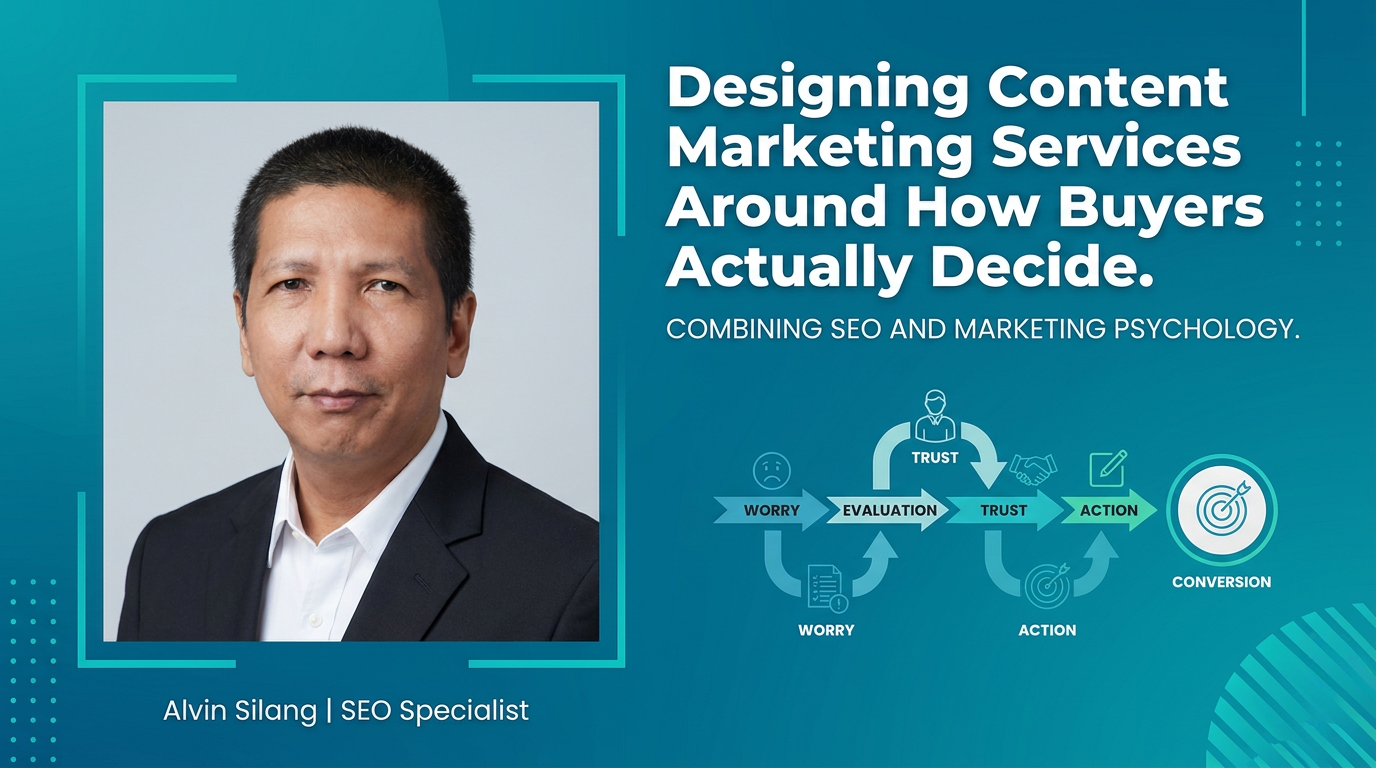
This is where combining SEO and marketing psychology gives you an advantage. You don’t just rank for "content marketing services"—you architect the page to follow the buyer’s mental path, so searchers feel understood, informed, and safe enough to take the next step.
Table of Contents
Start With the Moment They’re In, Not the Service You Sell
Most services pages open with a chest-beating headline:
"World-Class Content Marketing Services for Ambitious Brands"
That might impress you, but it doesn’t match the moment most searchers are in.
Search intent for "content marketing services" usually falls into two overlapping stages:
- Problem-aware / Solution-aware – They know content might help, but they’re fuzzy on how.
- Solution comparison – They’re shortlisting agencies or freelancers.
Psychologically, they’re scanning for two things:
- Relevance: "Do you solve my specific kind of problem?"
- Risk: "How likely is it that this goes badly for me?"
Rewrite your hero section to match that mental state.
Instead of leading with your greatness, lead with their situation and outcome:
-
Headline examples:
- "Content marketing services that turn searchers into sales calls."
- "Done-for-you content systems that bring in qualified leads, not just pageviews."
-
Subheadline examples:
- "For B2B companies that are publishing but not seeing pipeline growth—here’s how we fix the gap between traffic and revenue."
- "If your blog is busy but your inbox isn’t, our content services align SEO, psychology, and copy so buyers move from reading to reaching out."
This does three psychological jobs fast:
- Signals you understand their frustration.
- Connects your services to a business outcome, not just deliverables.
- Filters out the wrong fits without being aggressive.
Package Services Around Decisions, Not Internal Processes
Most teams package services around how they work:
- Bronze / Silver / Gold
- Blog Package / Social Package / SEO Package
- Starter / Growth / Scale
That’s easy for you, but it forces buyers to translate your packages into their own mental questions:
- "Will this help us get more qualified leads?"
- "Will this replace or support our internal team?"
- "How fast will we see anything measurable?"
A better approach is to name and structure your services around buyer decisions, not your internal workflows.
Consider three common decision lenses buyers use:
- Outcome-driven – "What will this change?"
- Engagement level – "How involved do I need to be?"
- Time horizon – "When will I see signals that this is working?"
You can turn those into service groupings:
-
Outcome-focused bundles
- "Lead-Gen Content System" – LPs, lead magnets, email sequences, traffic drivers.
- "Authority & SEO Growth Program" – topic clusters, long-form guides, digital PR.
- "Conversion Optimization Content Sprint" – UX copy, on-page SEO, CRO tests.
-
Engagement-level options
- "Plug-In Partner" – you handle strategy; their team executes content.
- "Done-With-You" – you co-create strategy and key assets, then hand off playbooks.
- "Done-For-You" – you own strategy, production, optimization, and reporting.
Then use copy to explicitly answer the unspoken decision question under each package:
- "If you want content that directly supports sales conversations within 60–90 days, this is for you."
- "If your team can write but needs a roadmap, choose this."
- "If you’re too busy to manage writers and editors, this is the no-handoff option."
The SEO side: you can still target core terms like "content marketing services", "content strategy services", or "B2B content marketing" in your headings and intro paragraphs while naming packages in a buyer-centric way. Searchers arrive via generic keywords, then recognize themselves in how you organize the page.
Make Invisible Risk Visible—and Then Reduce It
From a marketing psychology perspective, the biggest blocker on a services page isn’t price. It’s ambiguous risk.
Buyers rarely say, "This is too expensive" first. Their brain runs quieter scripts:
- "I’ve been burned before."
- "My boss will blame me if this doesn’t work."
- "I don’t understand exactly what I’m getting."
Your job is to surface and neutralize those fears in the copy, not hope visitors ignore them.
Work through these four risk types and address each directly:
-
Performance risk – "What if it doesn’t work?"
- Add focused proof near each service, not just a generic testimonials strip.
- Use before/after stats tied to the same type of service:
- "For a SaaS client publishing weekly blogs with no growth, we rebuilt their content strategy around search intent. Organic signups increased 172% in 8 months."
- Include negative-to-positive narratives ("from X to Y")—they mirror the buyer’s current-to-desired state.
-
Financial risk – "What if I waste budget?"
- Be transparent about timeframes:
- "In the first 30 days: we audit, research, and design your content roadmap. Months 2–3: we publish, optimize, and start seeing leading indicators—rankings, engagement, and pipeline influence."
- Offer scope clarity:
- Bullet what is always included vs. add-ons.
- State what you don’t do (e.g., "We don’t run paid ads; we partner with your existing team if you do.").
- Be transparent about timeframes:
-
Process risk – "What actually happens if we sign?"
-
Use a simple process section with plain-language stage names:
- "Clarify what success looks like for you."
- "Audit what you already have and find quick wins."
- "Design your content and SEO roadmap."
- "Produce, publish, and optimize content."
- "Review results and adjust monthly."
-
Under each, add a sentence or two answering: "What do you do? What do I do? When does this happen?"
-
-
Personal risk – "What if I look bad for choosing you?"
- Add credibility cues where the decision happens:
- Logos and short results near pricing sections.
- A brief "Who this is for / Who this is not for" block, so buyers feel smart for self-qualifying.
- A note about communication style and reporting (e.g., "Monthly strategy calls + dashboards your leadership can skim in 3 minutes").
- Add credibility cues where the decision happens:
You’re not just telling people it’s safe. You’re showing them how you’ve de-risked the engagement.
Align Your Page Structure With the Buyer’s Inner Dialogue
Think of your services page as a guided conversation where the buyer’s brain is asking questions in sequence.
A typical high-intent visitor flows through something like this:
- "Is this relevant to me?"
- "Do they seem credible?"
- "How does this work?"
- "Is this for my budget and situation?"
- "What’s the next safe step?"
Your page should follow that order as closely as possible.
A conversion-focused outline for a "Content Marketing Services" page might look like this:
-
Hero section – Relevance + outcome.
- Headline tied to results.
- Subheadline naming the types of businesses you help.
- Primary CTA: "Book a strategy call" plus a secondary: "View sample results" for people not ready yet.
-
Problems you solve – Mirror their pain.
- Short intro: "Most teams we work with are stuck in one of these situations:"
- 3–5 bullets:
- "Publishing content with no clear strategy or attribution."
- "Ranking for low-intent keywords that don’t convert."
- "Relying on one-off content campaigns instead of a system."
-
Services designed around decisions – Show your packages.
- Group services as discussed earlier (outcome-based, engagement level).
- For each: 1–2 sentences on who it’s for, bullets of deliverables, a clear expected time horizon.
-
Proof and process – Reduce performance and process risk.
- Case-study snippets with concrete metrics.
- Visual or numbered breakdown of your process linked to results.
-
Pricing philosophy – Frame the value, even if you don’t list numbers.
- If you can, include ranges or sample engagements (e.g., "Most clients invest between $X–$Y/month").
- Explain what drives investment up/down in plain language.
-
Objections section – "Is this really for us?"
- Quick FAQ focused on actual blockers:
- "What if we don’t have an in-house marketer?"
- "Do you require a long-term contract?"
- "How soon will we see any impact?"
- Quick FAQ focused on actual blockers:
-
Strong, low-friction CTA – One clear next step.
- Reassure them what will not happen: "No hard pitch. We’ll review your current content, suggest 2–3 opportunities, and you decide if you want help implementing."
Notice: SEO-wise, you can embed variations of "content marketing services", "content strategy", and niche modifiers ("B2B", "SaaS", "ecommerce") into headings and body copy naturally as you follow this structure.
Use Microcopy and UX to Nudge Hesitant Visitors Forward
The wording around your forms, CTAs, and sections can quietly increase conversions without changing your actual offer.
A few psychological levers to build into your UX:
-
Reduce commitment in CTA labels.
Swap "Schedule a consultation" (vague, heavy) for:- "Review my content strategy"
- "Get a free content audit outline"
- "See if we’re a fit"
-
Clarify what happens after a click.
Under your main button, add one line:- "You’ll answer 5 quick questions so we can review your current content before the call."
-
Use progress framing in forms.
Break long forms into 2–3 steps with labels like:- Step 1: About your business
- Step 2: Your content goals
- Step 3: How we can help
This taps into the goal-gradient effect—once people start, they’re more likely to finish.
-
Add social proof right where action happens.
Near CTAs and forms, place a short, relevant testimonial:- "Within six months, organic traffic increased 200% and qualified demo requests doubled—with the same ad spend."
-
Make your guarantee or safety net concrete.
Even if you don’t offer refunds, you can reduce perceived risk:- "If we’re not confident we can help, we’ll tell you on the call—no pressure and no follow-up sequence."
These are small shifts, but they compound. You’re guiding nervous system responses—reducing anxiety, clarifying effort, and signaling safety.
Tie It All Together With Search Intent
Everything above works even better when the traffic arriving on your page actually matches the mental state you’re designing for.
That’s where your keyword strategy comes in:
-
Primary intent keywords:
Target terms like "content marketing services", "B2B content marketing agency", or "content strategy services" on this page. These are high-intent, decision-stage searches. -
Supporting informational content:
Create separate guides for earlier stages, then link them in:- "What is a content marketing strategy?" (problem/supplier awareness)
- "Content marketing vs SEO vs paid ads" (solution comparison)
- "How long does content marketing take to work?" (expectation setting)
-
Internal links that nudge forward.
From those top-of-funnel guides, link into your services page with anchor text that matches the next psychological step:- "see how our content marketing services work"
- "explore content strategy services designed for B2B buying cycles"
You’re not chasing keywords in isolation. You’re building a path: from question, to understanding, to evaluating, to hiring.
When your content marketing services are named, packaged, and presented in line with how buyers think and feel, your website stops acting like an online brochure and starts behaving like a quiet, consistent salesperson—one that attracts the right visitors, answers their real questions, and moves them to book a call without pressure.