You’ve done the hard part.
You deliver real SEO results. Clients stay. Referrals trickle in.
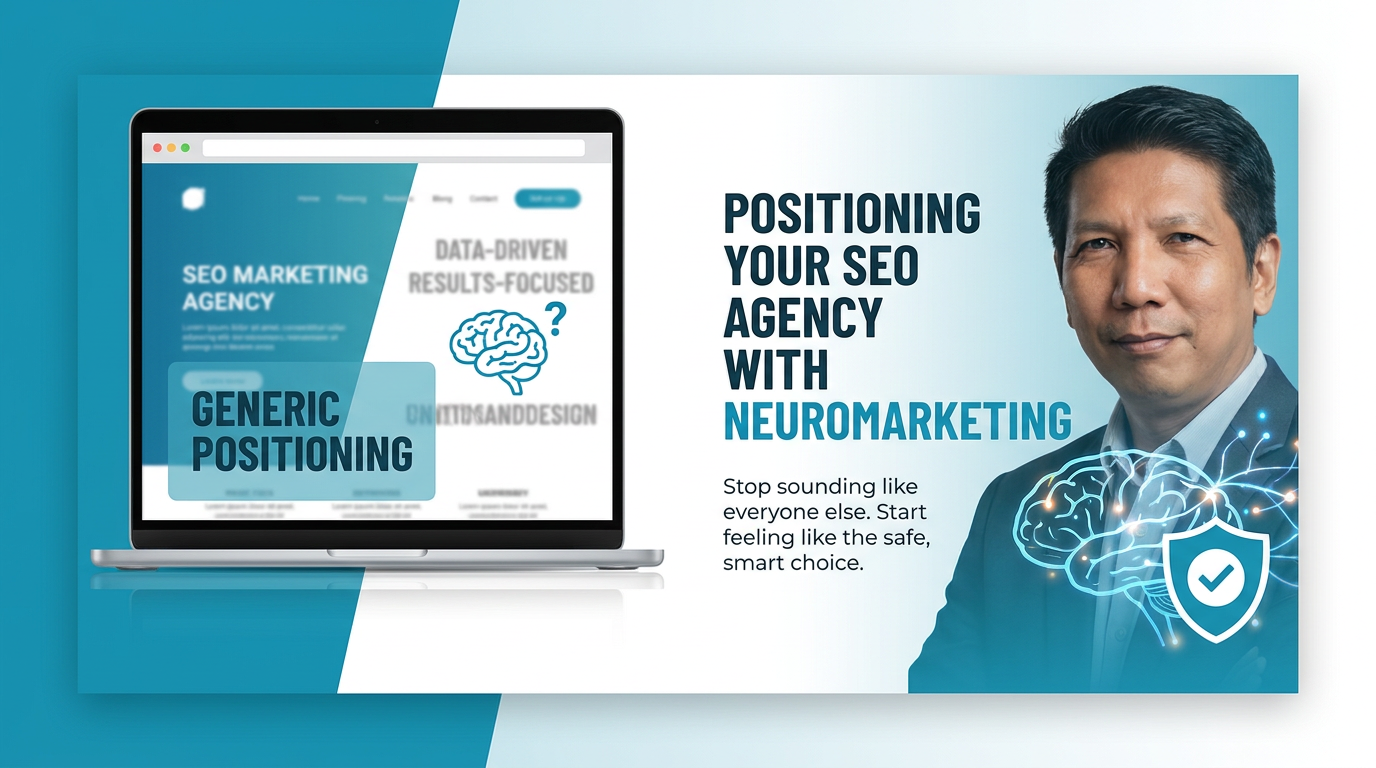
But when a cold prospect lands on your site, your "SEO marketing agency" suddenly looks like every other one: "data‑driven", "results‑focused", "full‑service", a hero banner with a laptop mockup, and a vague "Get Started" button.




The problem isn’t your work. It’s your positioning — and the way your website speaks to the brain that’s actually deciding whether to contact you.
Neuromarketing isn’t about tricks. It’s about recognizing that your visitors don’t read every word, compare every offer, and weigh every argument. They scan. They look for cues: "Can I trust you? Are you for people like me? Will I look stupid if this fails?" If your site doesn’t answer those fast, they bounce to the next tab.
This is where you stop sounding like an agency and start feeling like a safe, smart choice.
Table of Contents
Start with the one job of your homepage: reduce risk in 5 seconds
Most agencies treat the homepage like a brochure: "We are an SEO marketing agency helping brands grow with data‑driven strategies".
From a neuromarketing standpoint, the homepage has one core job: reduce perceived risk fast enough that the visitor’s brain doesn’t hit the back button.
You do that by:
- Making it obvious who you’re for
- Showing evidence you can deliver
- Giving a low‑risk next step
Rework your above‑the‑fold section around those three questions:
-
"Am I in the right place?"
Use a tight, specific headline instead of a generic claim.- Weak: "Full‑Service SEO Marketing Agency"
- Strong: "SEO Marketing Agency for B2B SaaS Hitting a Plateau at $50k–$300k MRR"
The brain is wired to notice self‑relevance. Numbers and niches are relevance cues.
-
"Can I trust you?"
Don’t hide your best credibility cues below the fold.- Add a proof bar right under the hero text: client logos, "Grew organic demos by 212%", "Featured in…"
- Use real numbers, timeframes, and named industries: "150%+ organic growth in 6–12 months for B2B and D2C brands."
-
"What’s the safest next step?"
Many homepages jump straight to "Book a discovery call". For a cold visitor, that feels high‑commitment.Instead, frame your main CTA as a diagnostic that benefits them even if they don’t hire you:
- "Request a 15‑Minute SEO Opportunity Review"
- "Get a Free SERP Gap Snapshot for Your Top 3 Keywords"
This taps loss aversion: "If I don’t click, I might miss a free insight that helps me." It feels less like being sold and more like avoiding a loss.
Replace buzzwords with proof and specificity
Buzzwords exist because they’re easy to write and hard to argue with.
But they’re also invisible to the brain. When someone has seen "data‑driven SEO" and "ROI‑focused growth" on ten other sites, their attention system files those phrases under "already processed, safe to ignore".
Your job is to replace abstract claims with concrete evidence the brain can picture.
Walk through your homepage and service pages and highlight every vague phrase like:
- "data‑driven"
- "results‑oriented"
- "tailored strategy"
- "end‑to‑end solutions"
- "holistic approach"
Then rewrite them using one of these neuromarketing‑friendly lenses:
-
Sensory and specific language
The brain responds to concrete detail.- Instead of: "data‑driven SEO strategies"
- Use: "technical audits, content gap analysis, and A/B‑tested on‑page changes, tracked weekly in a shared dashboard"
-
Before/after contrast
Humans decide through contrast, not absolute numbers.- Instead of: "we improve your rankings"
- Use: "we’ve taken B2B sites from page 3 to top 3 positions for 20+ commercial keywords in under 9 months"
-
Named processes
A named process or framework (if it’s real) becomes a mental shortcut for competency.- Instead of: "custom SEO roadmap"
- Use: "a 90‑day roadmap built from our 4‑step Growth Signal Framework: crawl, consolidate, create, convert"
Review every section with this test: Could a competitor paste this exact sentence on their site without changing anything?
If yes, rewrite it.
Turn your services page into a decision support tool, not a menu
Most "SEO marketing agency" service pages are long lists:
- Technical SEO
- On‑page SEO
- Content strategy
- Link building
- Local SEO
That’s a taxonomy, not a sales asset.
The brain doesn’t think in services. It thinks in jobs to be done and risks to avoid.
Restructure your services page around problems and outcomes rather than internal categories.
Step 1: Group services by buyer problem
Arrange sections like this instead:
- "When you’re invisible on Google (no rankings, no traffic)"
- "When you rank but leads are low‑quality or don’t convert"
- "When your content team is publishing, but growth has flatlined"
Under each, list the relevant services and expected outcomes:
- "We typically combine a technical audit, information architecture refresh, and content gap strategy to fix this. Expect: 3–5x more impressions and 50–150% organic traffic growth in 6–12 months, depending on your baseline."
Now your page matches the internal monologue of the visitor, not your org chart.
Step 2: Build in loss aversion ethically
Loss aversion means people are more motivated to avoid a loss than to gain an equivalent win.
You can apply this without fearmongering by showing what happens if they maintain the status quo.
Use copy like:
- "Staying on page 2–3 means competitors capture 80–90% of the clicks for your highest intent keywords."
- "Without a conversion‑focused content strategy, you’re paying writers to grow traffic that never turns into pipeline."
Pair each with a corresponding positive outcome. You’re not threatening; you’re clarifying.
Step 3: Add "Who this is NOT for" filters
Counterintuitively, disqualifying some prospects increases closes with the right ones. It signals confidence, reduces perceived risk, and triggers a sense of fit.
Add a short "Who this is for / not for" block on the services page:
- This is for you if:
- You already generate at least 50–100 leads/month from any channel
- You’re willing to act on recommendations within 30 days
- This is not for you if:
- You expect SEO to replace ads in 30 days
- You won’t give access to analytics or CMS
Prospects read this and unconsciously think, "They’ve done this enough to know when it fails." That lowers their fear of wasting time and money.
Make case studies the star, not the appendix
If your homepage and services pages reduce risk in theory, case studies reduce it in practice.
But many agencies bury them under a generic "Our Work" tab, or write long narratives nobody reads.
You want scan‑friendly, outcome‑first stories that map to how the brain recalls information.
Structure every case study around three questions
Use the same skeleton for each:
-
"Where did they start?"
- Include niche, size, and baseline metrics: "VC‑backed B2B SaaS, 40 employees, ~3,000 monthly organic visits, <10 demo requests per month from search."
-
"What did you actually do?"
- Keep this to 3–5 specific moves, not 20 tactics.
- "Consolidated 63 blog posts into 17 topic clusters."
"Rebuilt internal links to prioritize 12 money pages."
"Rewrote top 10 blog intros to match searcher intent."
-
"What changed?"
- Show numbers and what they mean.
- "Organic traffic: +188% in 9 months (3,000 → 8,640 visits/month)."
"Demo requests from organic: +220% (9 → 29/month)."
"Projected pipeline from SEO: +$80k/month."
Now add two neuromarketing pieces most agencies skip:
-
Social identity cues
Use quotes that show how your client thinks, not just what they got:- "We finally felt confident pausing low‑performing ad groups because SEO was filling the gap."
- "For the first time, we had a clear content plan tied to pipeline, not pageviews."
These lines let your prospect imagine themselves feeling that way.
-
Visual proof of movement
Use simple, annotated graphs:- 9‑month traffic graph with two callouts: "Technical clean‑up" and "Content launch"
- Screenshot of a SERP showing their site in top 3
Graphs exploit the brain’s sensitivity to visual trend lines — quickly encoding "up and to the right" as "good" without heavy reading.
Connect case studies from core pages
Don’t force users to hunt. From your homepage and services page, link specific phrases to relevant case studies:
- Under your "When you rank but don’t convert" section, link to a case study about lifting conversions from organic.
- Next to your "Technical SEO" mention, link to a case about fixing crawl/indexing issues.
This supports the brain’s desire for cognitive ease: minimal effort to verify a claim.
Use design and microcopy to signal "safe and easy" at every step
Positioning isn’t just words. Small design decisions constantly whisper "this is safe" or "this might be painful".
Focus on three areas: navigation, forms, and CTAs.
Navigation that calms, not confuses
Overstuffed menus create friction. The brain hesitates when there are too many choices.
Aim for a simple top‑level nav:
- Services
- Results (case studies)
- Process or How We Work
- Pricing or Engagements (even if it’s ranges)
- Resources (optional)
- Contact
Use labels in plain language. Avoid "Solutions", "Capabilities", "Insights" — they don’t map to how a buyer thinks.
Forms that feel human and low‑risk
Form friction can kill all the careful positioning you’ve done.
Apply these neuromarketing‑based tweaks:
-
State what happens next above the form
- "We’ll review your site and reply within 1 business day with 2–3 specific opportunities. No sales pressure."
-
Limit fields to only what you truly need to respond meaningfully.
Every extra field is a micro‑cost. -
Use microcopy to reduce fear under sensitive fields:
- Under "Budget": "A range is fine. This only helps us recommend the right approach."
- Under "Website access": "We’ll never change anything without written approval."
These lines speak directly to the brain’s fear centers: uncertainty, loss of control, and potential embarrassment.
CTAs that respect autonomy
Autonomy is a powerful motivator. People resist feeling pushed.
Instead of aggressive CTAs like "Schedule Your Strategy Call Now", test:
- "See if we’re a fit"
- "Review my SEO opportunities"
- "Ask us to pressure‑test your current strategy"
Combine these with a secondary, even lower‑risk option:
- Primary: "Request a 15‑minute review"
- Secondary: "Email us your questions"
This gives people a sense of control and lowers the psychological barrier to initiating contact.
Turn your site into a silent pre‑sales team
Positioning your SEO marketing agency with neuromarketing is not about clever hacks. It’s about respecting how real buyers actually think:
- They scan for relevance and risk reduction in seconds.
- They trust concrete proof over adjectives.
- They respond to avoided losses more strongly than potential gains.
- They prefer to feel in control of the next step.
When your homepage immediately signals "we work with companies like yours", your services page mirrors their real problems, and your case studies make the upside and downside vivid, your website stops acting like a digital brochure.
It becomes a pre‑sales team member that:
- Filters out bad‑fit leads
- Warms up good‑fit leads before the first call
- Shortens sales cycles because objections are handled upfront
If you’ve already read the earlier piece on ethical persuasive content, this is the natural extension for your own agency. From here, you can later plug your neuromarketing‑ready site into a broader SEO and digital funnel, so every touchpoint speaks to the same brain — and nudges it toward a confident "yes" instead of a cautious "maybe later".